Survival Tips for Pastors

How to encourage your pastor

Much is written about how vulnerable pastors are to criticism by church members. But apart from an annual reminder of Pastor Appreciation Month (what’s that, you say?), little is said about the incredible power church members have to encourage and sustain their pastors.

That’s why I want to share an email that a member of my church sent to me and my colleagues this morning. The subject line read “Praying for You,” and the message was,

Good Morning, Gentlemen.
As I was reading this morning, the last lines of 2 Thessalonians 1 immediately made me think of you…and so I prayed for each of you: “To this end we always pray for you, that our God may make you worthy of His calling and may fulfill every resolve for good and every work of faith by His power, so that the name of our Lord Jesus may be glorified in you, and you in Him, according to the grace of our God and the Lord Jesus Christ.” 
May you continue to see God being glorified before you so that you are more and more amazed at His love, power, goodness, grace and fall more in love with Him.
I am truly thankful for the ways you’ve impacted my life.
Thank you for following Him.
I have a “Keepers” folder in my email program. That email went into that folder so I can look at it again and again to fend off discouragement. It made my day…no, my week!
Church member, if you’re reading this, know that a brief email or text of appreciation and prayer can put spring back in the step of your pastor. Don’t underestimate the power of your encouraging words.

Easter is hard on pastors

Thom Rainer posted eleven reasons pastors struggle when Easter Sunday comes around.

  1. The day is often overwhelmingly busy.
  2. The pressure to “do stresswell” is increased.
  3. Finding a unique approach to the Easter story is not easy.
  4. Pastors see members they haven’t seen since last Easter.
  5. Pastors see “lostness” come in the door . . . and leave unchanged.
  6. Pastors get a glimpse of what the church could be . . . but typically isn’t.
  7. Pastors often judge their own sermons more critically on Easter.
  8. Pastors brag about Easter attendance.
  9. Attendance expectations may not be met.
  10. Monday morning letdown can follow Easter.
  11. Some pastors have no resurrection joy themselves.

I especially resonate with Reason #2–the pressure to “do well” on Easter Sunday is intense. More people are sitting in our pews on Resurrection Sunday. We think to ourselves, “If I do well, they’ll come back.” We feel compared to other pastors and worry that our performance won’t match up. Even our own faithful members are hoping for an extra-good display of our gifts, especially if they brought friends and family along.

It’s tempting to find our identity in the comments people give us after the service: “Great sermon, pastor! God really spoke through you today, pastor!” Our innate sense of self-importance, our vanity, the expectations of fellow fallen people, and the devil himself conspire to make Easter Sunday anything but a day of gladness and celebration for pastors.

Here are words from God that may help you get through the Easter weekend with joy: “Fear not, for I have redeemed you; I have called you by name, you are mine. When you pass through the waters, i will be with you; and through the rivers, they shall not overwhelm you; when you walk through fire you shall not be burned, and the flame shall not consume you. For I am the Lord your God, the Holy One of Israel, your Savior” (Isaiah 43:1-3a, ESV).

If you’re reading this and you’re not a pastor, pray for your pastoral team this weekend. You may be unaware of the burdens they are carrying.

What pastors face today

The work of leading God’s people has always been, and by definition always will be, challenging. But today’s pastors face unique pressures. If you’re a church leader sinking under the weight of these pressures, Barnabas Ministries can help.

Barnabas Ministries is a network of people and resources that exists to “connect, encourage, inspire, and enable pastors” in their calling. Check out what they have to offer hpastoral-pressuresere.

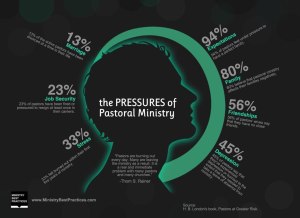
On the Barnabas Ministries website is this helpful graphic taken from Pastors at Greater Risk by H. B. London. It gives you a sense of some of the daunting challenges pastors face today. To this list I would add:

– The celebrity culture in which we live, that denies the glory of the ordinary;

– The pastor’s own insecurities and need for approval;

– The financial problems plaguing our nation and members of the congregation;

– Opposition by Satan, who despises God, the church, church members and church leaders;

– And the increasing suspicion and hostility of the world, which is by nature allergic to God.

All these pressures, and more, demand that we be people who keep in step with the Spirit, fight the good fight of faith, have a set of close friends on whom we can rely, and live out of the Savior’s great love for us in the gospel.

Patience

I met with a fellow ministry leader today who reminded me of a beautiful word: patience.

Pastors are typically not very patient people. We want to see God moving in our congregations. We want to see lives change, prayers answered, the lost found, the saved sanctified. NOW!

I should know. I’m a pastor and I’m not a very patient person.

The thing is, God is an incurably patient God.

Sure, sometimes he acts quickly: shock and awe! But my experience has been that, more often than not, God is in neither the wind, nor the earthquake, nor the fire, but the low whisper that Elijah heard (1 Kings 19:9-12). That’s why God tells us not to despise the day of small things (Zechariah 4:10). Don’t be an impatient pastor. Just be faithful, rejoice when God grants small, incremental gains. Be a pastor who prays, and serves, and cares for your soul, and…waits.

Be patient.

What to remember when you’re suffering

When we are hurting, it helps to pull out one of the preachers of old and hear him remind us that God ordains affliction for our good and his glory. Here’s what the “Prince of Preachers,” Charles Spurgeon (1834-1892), said about the benefits of suffering:

“God’s great design in all his works is the manifestation of his own glory. Any aim less than this were unworthy of himself. But how shall the glory of God be manifested to such fallen creatures as we are? Man’s eye is not single, he has ever a side glance towards his own honour, has too high an estimate of his own powers, and so is not qualified to behold the glory of the Lord. It is clear, then, that self must stand out of the way, that there may be room for God to be exalted; and this is the reason why he bringeth his people ofttimes into straits and difficulties, that, being made conscious of their own folly and weakness, they may be fitted to behold the majesty of God when he comes forth to work their deliverance. He whose life is one even and smooth path, will see but little of the glory of the Lord, for he has few occasions of self-emptying, and hence, but little fitness for being filled with the revelation of God. They who navigate little streams and shallow creeks, know but little of the God of tempests; but they who “do business in great waters,” these see his “wonders in the deep.” Among the huge Atlantic-waves of bereavement, poverty, temptation, and reproach, we learn the power of Jehovah, because we feel the littleness of man. Thank God, then, if you have been led by a rough road: it is this which has given you your experience of God’s greatness and lovingkindness. Your troubles have enriched you with a wealth of knowledge to be gained by no other means: your trials have been the cleft of the rock in which Jehovah has set you, as he did his servant Moses, that you might behold his glory as it passed by. Praise God that you have not been left to the darkness and ignorance which continued prosperity might have involved, but that in the great fight of affliction, you have been capacitated for the outshinings of his glory in his wonderful dealings with you.” (Morning and Evening, July 19)

How do you handle failure?

I’ve come across a new book that looks like a great read. It’s called Fail: Finding Hope and Grace in the Midst of Ministry Failure, by J. R. Briggs. According to Scot McKnight the book deals with “four basic areas downloadof failure for pastors:

1. Mighty fall: sexual, moral failures

2. Tragic event: cancer, shocking terminations, betrayals

3. Slow leak: wearing down of the soul. Constant drips of discouragement

4. Burned out: crisis to crisis wears a pastor down. The system overheats and it burns out.”

Add to these things the other pressures faced by ministers of the gospel (expectations of success and church growth, the allure of celebrity, the constant need to produce rich Bible messages, staff demands,
etc.), and you have a real recipe for debilitating guilt and shame.

Looks like a must read.

Pain by numbers

One of the keys to surviving in ministry is being open about your pain.

During the General Assembly of the Presbyterian Church in America (my denomination), which met in Houston this past week, I sent out this tweet:

Screen Shot 2014-06-20 at 6.42.40 PM

In no time at all, I got new Twitter followers and a number of retweets and favorites from people I don’t even know. Several pastor friends who had seen my tweet came up and thanked me for it. I’m guessing they just needed someone to tell them they weren’t crazy.

So many ministers of the gospel are carrying the scars of ministry but think they are alone. They are not. According to reputable studies and surveys…

  • 1,500 pastors leave their ministries each month due to burnout, conflict, or moral failure.
  • 23% of pastors have been fired or pressured to resign at least once in their careers.
  • numbers25% don’t know where to turn when they have a family or personal conflict or issue.
  • 33% felt burned out within their first five years of ministry.
  • 40% of pastors and 47% of spouses are suffering from burnout, frantic schedules, and/or unrealistic expectations.
  • 45% of pastors’ wives say the greatest danger to them and their family is physical, emotional, mental, and spiritual burnout.
  • 45% of pastors say they’ve experienced depression or burnout to the extent that they needed to take a leave of absence from ministry.
  • 50% feel unable to meet the needs of the job.
  • 52% of pastors say they and their spouses believe that being in pastoral ministry is hazardous to their family’s well-being and health.
  • 56% of pastors’ wives say they have no close friends.
  • 57% of pastors would leave the pastorate if they had some other option.
  • 70% don’t have any close friends.
  • 75% report severe stress causing anguish, worry, bewilderment, anger, depression, fear, and alienation.
  • 80% of pastors say they have insufficient time with their spouse.
  • 80% believe that pastoral ministry affects their families negatively.
  • 90% feel unqualified or poorly prepared for ministry.
  • 90% work more than 50 hours a week.
  • 94% feel pressured to have a perfect family.
  • “Members of the clergy now suffer from obesity, hypertension and depression at rates higher than most Americans. In the last decade, their use of antidepressants has risen, while their life expectancy has fallen. Many would change jobs if they could” (New York Times, August 1, 2010).

I share this not to create sympathy for pastors nor to give you pastors a reason to boast in your wounds, as though they make you righteous. But we have to admit to ourselves that pastoral ministry is HARD.

The Puritan Richard Baxter (1615-1691) pastored a church in Kidderminster, England, for close to twenty years. He wrote in his journal one day, “…the more I do, the more hatred and trouble I draw upon me.” Marshall Shelley, in his book Leading Your Church through Conflict and Reconciliation, says, “The only pastors who don’t experience regular, character-building periods of conflict, are either bullies who walk all over everyone or cowards afraid to stand up for what God wants to accomplish.”

If there’s one thing I’ve found necessary for my own ministry survival, it is to come out of hiding. Let someone you trust know what you’re going through. Don’t suffer in silence.


The best advice I was ever given

Years ago, while I was still in seminary, a man who mentored me gave me the best advice I’ve ever received.

He said you minister out of who you are.

At the time, I’m not sure I understood what he meant. Or at least I didn’t grasp the importance of it. But through the years in pastoral ministry, I have come to see the wisdom and value of his words.

On the one hand it’s a statement of fact. You can only fake it so long. You cannot give what you don’t have. So my mentor’s advice means that to be effective in ministry, I must prioritize my own spiritual health. I must, in the words of Proverbs 4:23, keep my heart with all vigilance, “for from it flow the springs of life.”

But on the other hand, my friend’s advice was a word of comfort as well as charge. In ministry, I do not have to be other than who I am. I do not have to be Tim Keller or Rick Warren or Francis Chan or any other pastor. God designed me the way He did for a reason. It’s not that I don’t need further sanctification–God knows I do. And it’s not that sometimes I don’t have to push myself out of my comfort zone and try things that are difficult for me–I do every day! But when all is said or done, I am who I am. I am an ISFJ. I am insecure. I am not good at telling jokes. I need notes in the pulpit. I’m a plodder, not a sprinter. I’m better with people than plans. I get nervous before elder meetings. I have a hard time seeing beyond the next couple of months. I’m a shepherd, not a fundraiser-motivator-debater-theologian-cheerleader-visionary.

And that’s OK. No, it’s very good.

Because I am needed in the battle, just the way I am.

It’s when I try to be someone I’m not, that all the life and energy go right out of me. I get pressured and stressed and worried and angry. And that’s not what God wants for me or His church.

You minister out of who you are. Take that to the bank. You’re a beloved child of God. Sure, you need to grow. There are areas of your life that are in serious need of improvement. Me, too. But in the meantime, the Lord your God is with you. He rejoices over you with gladness, quiets you by His love, and exults over you with loud singing (Zephaniah 3:17).

Be who you are, and you’ll be a better pastor. Not only that, you’ll enjoy being a pastor a whole lot more.


Don’t forget, pastor…

imagesWhen you feel the pressure to perform, to succeed, to grow your church…

When fellow leaders tell you they want to see more results…

When the voice inside your head tells you you’re not good enough…

That’s when you must remember:

You’re a minister of the gospel, not the bottom line.

Even Paul said, “I planted, Apollos watered, but God gave the growth” (1 Cor. 3:6).

Just be faithful. Do your part.

Be content to fill a little space, if God be glorified.

Five things the devil tells pastors

In our work awhispers pastors, an evil alliance conspires for our discouragement. The world, the flesh, and the devil try to wear us out, bring us down, chew us up, and take us out of the fight. These are the same enemies every Christian faces, but they operate in us pastors in unique ways.

Take the devil (yes, take him, PLEASE!). He hates what we’re doing. Just as Satan tried to derail Jesus in the wilderness through persuasive words (Matt. 4:1-11), so he suggests things to us pastors that, if believed, will kill our joy and effectiveness in ministry. Jesus said the devil is a really good liar. “He…does not stand in the truth, because there is no truth in him. When he lies, he speaks out of his own character, for he is a liar and the father of lies” (John 8:44).

I’ve identified five things the devil regularly tells me because he hates me and hates my church. Sometimes he uses people to say these things. But usually my own sinful nature gives him all the help he needs. Notice that hidden inside each lie is a small grain of truth.

1) Lie #1: “You’re amazing.”

“You’re indispensable,” the devil says to me. “After all, you have training, gifts, and experience no one else has. Nobody else can get the job done like you can. As for your preaching, why, it’s extraordinary–it just hasn’t been discovered yet. And your spiritual insights–incredible! If only people would pay attention to you, their lives would be so much more fruitful. What’s the matter with them?!”

2) Lie #2: “You’re awful.”

“Listen to yourself,” says Satan in the next breath. “The very fact that you think those elevated thoughts about yourself just goes to prove how proud, arrogant, and self-reliant you are. What kind of pastor–what kind of Christian–would be so boastful? Don’t you know God doesn’t use dirty vessels? You’re such a hypocrite. You might as well hang it up, dude.”

3) Lie #3: “Get busy!”

“I have a suggestion, pastor: Get to work. Stop thinking about yourself all the time. There are souls to be saved, battles won, cities rescued, nations evangelized! Why are you wasting time talking to that Forlorn Freddie when there are so many more important things to do? You haven’t a moment to lose. It’s fine if you want to pray for a little while, but God wants results.”

4)  Lie #4: “Relax.”

“OK, maybe I went a little overboard,” the devil says. “You’re right, you need a break. Hardly anybody Sabbaths anymore–you need a Sabbath. In fact you need a sabbatical. You’re working too hard. Every soldier needs a furlough. Don’t worry about those souls, battles, cities, and nations. You believe in predestination, don’t you? God’s going to do what he’s going to do. You’ve done all you can. Let the chips fall.”

5)  Lie #5: “It’s hopeless.”

“You’re a mess, pastor. And so is your church. Look at the numbers: your church is not growing. In fact, Christianity is declining everywhere you look. Islam is growing like gangbusters, but not Christianity. Looks like you guys are losing ground. The bad guys are winning, pastor. The church looks more and more like the world all the time. You still think the kingdom of God is advancing?? How long are you going to hold on to that foolish idea?!”

These are just a few of the often contradictory messages I hear from our enemy, the devil. What does he tell you, and how have you learned not to listen to him?