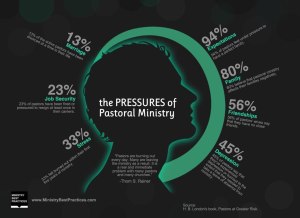
What pastors face today

The work of leading God’s people has always been, and by definition always will be, challenging. But today’s pastors face unique pressures. If you’re a church leader sinking under the weight of these pressures, Barnabas Ministries can help.

Barnabas Ministries is a network of people and resources that exists to “connect, encourage, inspire, and enable pastors” in their calling. Check out what they have to offer hpastoral-pressuresere.

On the Barnabas Ministries website is this helpful graphic taken from Pastors at Greater Risk by H. B. London. It gives you a sense of some of the daunting challenges pastors face today. To this list I would add:

– The celebrity culture in which we live, that denies the glory of the ordinary;

– The pastor’s own insecurities and need for approval;

– The financial problems plaguing our nation and members of the congregation;

– Opposition by Satan, who despises God, the church, church members and church leaders;

– And the increasing suspicion and hostility of the world, which is by nature allergic to God.

All these pressures, and more, demand that we be people who keep in step with the Spirit, fight the good fight of faith, have a set of close friends on whom we can rely, and live out of the Savior’s great love for us in the gospel.

Patience

I met with a fellow ministry leader today who reminded me of a beautiful word: patience.

Pastors are typically not very patient people. We want to see God moving in our congregations. We want to see lives change, prayers answered, the lost found, the saved sanctified. NOW!

I should know. I’m a pastor and I’m not a very patient person.

The thing is, God is an incurably patient God.

Sure, sometimes he acts quickly: shock and awe! But my experience has been that, more often than not, God is in neither the wind, nor the earthquake, nor the fire, but the low whisper that Elijah heard (1 Kings 19:9-12). That’s why God tells us not to despise the day of small things (Zechariah 4:10). Don’t be an impatient pastor. Just be faithful, rejoice when God grants small, incremental gains. Be a pastor who prays, and serves, and cares for your soul, and…waits.

Be patient.

What Does Jesus Smell Like?

I recently needed a children’s message on peacemaking, so this is what I came up with…

Title: “What Does Jesus Smell Like?”

Scripture text: 2 Corinthians 2:15

Materials you need: a spray bottle of air freshener; a spray bottle of Deer-Off (or something else that smells terrible!)

Opening question: Are you a peacemaker or a peace-breaker?

Message: God tells us to make peace whereverimage and whenever we can. But sometimes we get into fights, don’t we? Sometimes we complain, and whine, and fuss, and demand we get our way. In James 4:1 God says, “What causes quarrels and what causes fights among you? Is it not this, that your passions are at war within you?”

When we lose control and let our passions take over, we become peace-breakers. It’s like we spread an awful smell. Take a whiff of this, boys and girls. (Spray some Deer-Off into a bowl and let the children smell it. Careful! Don’t spill it on the floor or let anyone put their fingers in the bowl! If you’ve never smelled Deer-Off, it’s horrible!)

But when we try to make peace with others, it’s like we spread a nice, sweet smell, like this (spray some good air freshener around the children). 

What are some ways you can spread peace? (Help the kids think of being a peacemaker at home with their siblings, or at school with friends, or in the neighborhood with people they may not like). 

Every time you’re a peacemaker, you spread the aroma of Jesus. It says in 2 Corinthians 2:15, “For we are the aroma of Christ to God among those who are being saved and among those who are perishing.”

Jesus died on the cross so that we could be at peace with God. He calls you to make peace with people around you. When you fail, confess your sin to God. The blood of Jesus will cleanse you from sin and help you spread the pleasing aroma of Jesus wherever you go.

Is this your story?

A pastor who will remain nameless sent me this text message:

Can’t tell you how many times I had to get in pulpit when felt like life was crashing around me and when family seemed to be falling apart. I hold on to the passage that in our weakness He is strong.

What lie about pastoral ministry have we bought into that convinces us our value is determined by how well we entertain in the pulpit, how fast our church is growing, how quickly we get our church out of debt, or how many Twitter followers we have?

When did we decide it’s a bad idea for pastors to have really close friends within their church or to be honest about their failures?

Why must a pastor also be a marketing genius, a fundraiser, a scholar, a motivational speaker, a CEO, a social media guru, and a politician to be considered “effective”?

The stress level on ministers of the gospel today is screaming that it’s time we redefine the work of a pastor. Biblically, here’s the definition:

“Pay careful attention to yourselves and to all the flock, in which the Holy Spirit has made you overseers, to care for the church of God, which he obtained with his own blood” (Acts 20:28, ESV).


Darren’s Story

Darren (not his real name) is a steady, humble, compassionate man. A great pastor. A faithful teacher of God’s Word.

in-depression-630x315But one day, he crashed.

Fresh out of seminary nearly thirty years ago, Darren accepted a call to a small church in an Appalachian community. He was the first full-time pastor the church had ever had. The average age of its two-dozen members was sixty-five. But Darren still carries warm memories of his time among them. He and his wife were married while he served in this little town. Their first child was born there too. But it was clear Darren’s gifts could be used in a wider sphere.

Darren moved his young family to a church in Alabama where he was the solo pastor for nearly ten years. They had a second child. The church held steady in membership. It was a happy experience. But a new opportunity presented itself in the spring of 2000. Darren accepted a call to a bigger church in another Southern suburb.

This church, Darren says, was “dysfunctional.” Darren’s predecessor had been asked to leave. He had replaced a man who was highly regarded—not as a great preacher or administrative leader but as a warm, loving pastor. Unfortunately, Darren’s predecessor was the very opposite. He just didn’t fit. So when Darren arrived, he knew he would need to take his time, build trust, and give the church some much-needed stability. And he did just that.

Things went well for several years. Darren led a reorganization of the elder board and faithfully taught the Bible. But Darren found it a tough church to pastor. People were all over the map theologically. Some voiced their opposition to Darren’s Bible teaching. Some of the people had bad attitudes toward church leaders. Members of the worship team wanted control. Previous elders had refused to confront sin in the church. Now, when the elders tried to put policies in place, some members didn’t like it. Disgruntled, a contingent left the church for greener grass. Several of Darren’s key supporters and friends also left because of job changes. Worse yet, Darren’s assistant pastor, who was a close friend, accepted a call to another church. These losses were hard on Darren and his wife.

Two other events pushed Darren over the edge. He had to put his beloved dog to sleep. But much more devastating, his mother was slowly declining into Alzheimer’s disease. Darren knew she could no longer care for herself, so he moved her out of her house many miles away into an assisted living facility near him. She hated her new home. It was far away from everything familiar. She grew increasingly adversarial, begging Darren over and over to take her back home. But there was no way.

Darren’s mom eventually passed in December, 2013. But her mental and emotional decline, on the heels of all the other losses Darren had experienced, took a terrible toll on him. He shut down emotionally and became almost non-functional. The day of the “crash,” Darren’s wife called the elders and said Darren would not be able to preach that weekend…and maybe not for a long while. He couldn’t get out of bed. He could hardly even speak. For weeks, doing anything at all required enormous energy. Night after night he couldn’t sleep. He says he was never suicidal, but he felt overcome with stress, sadness, and fear.

A caring, older couple invited Darren and his wife to move into their home for as long as they needed. Darren took the next two months off. He got counseling and got on an antidepressant. Slowly the darkness began to lift. He eventually felt like doing a bit of church work. The congregation was very understanding, he says. He was honest with them. He told them about his stress, his sadness, his tendency to isolate himself and not depend on the help of others. Being vulnerable and open actually drew him closer to his people. He grew more understanding of people’s pain. He says he learned the value of sighing.

But in the months following his return, Darren realized something had changed inside him. He no longer felt that he “fit” as a senior or solo pastor.

So earlier this year, Darren resigned.

Darren is now asking the questions he says he should have asked a long time ago: “What’s my gift mix? Where does God want me? What was I made for?” Darren is considering teaching, writing, and mentoring younger pastors.

I asked Darren what, if anything, might have prevented him from crashing in ministry. He says, “If I had grasped that God is for me, that would have helped.” Darren also says he’s realized that as a pastor he always felt isolated, like he was living on an island.

“I’m ready for something different now,” he says.

What to remember when you’re suffering

When we are hurting, it helps to pull out one of the preachers of old and hear him remind us that God ordains affliction for our good and his glory. Here’s what the “Prince of Preachers,” Charles Spurgeon (1834-1892), said about the benefits of suffering:

“God’s great design in all his works is the manifestation of his own glory. Any aim less than this were unworthy of himself. But how shall the glory of God be manifested to such fallen creatures as we are? Man’s eye is not single, he has ever a side glance towards his own honour, has too high an estimate of his own powers, and so is not qualified to behold the glory of the Lord. It is clear, then, that self must stand out of the way, that there may be room for God to be exalted; and this is the reason why he bringeth his people ofttimes into straits and difficulties, that, being made conscious of their own folly and weakness, they may be fitted to behold the majesty of God when he comes forth to work their deliverance. He whose life is one even and smooth path, will see but little of the glory of the Lord, for he has few occasions of self-emptying, and hence, but little fitness for being filled with the revelation of God. They who navigate little streams and shallow creeks, know but little of the God of tempests; but they who “do business in great waters,” these see his “wonders in the deep.” Among the huge Atlantic-waves of bereavement, poverty, temptation, and reproach, we learn the power of Jehovah, because we feel the littleness of man. Thank God, then, if you have been led by a rough road: it is this which has given you your experience of God’s greatness and lovingkindness. Your troubles have enriched you with a wealth of knowledge to be gained by no other means: your trials have been the cleft of the rock in which Jehovah has set you, as he did his servant Moses, that you might behold his glory as it passed by. Praise God that you have not been left to the darkness and ignorance which continued prosperity might have involved, but that in the great fight of affliction, you have been capacitated for the outshinings of his glory in his wonderful dealings with you.” (Morning and Evening, July 19)

Listen to Jesus!

Need a children’s sermon on the Transfiguration? Try this one…

Title: “Listen to Jesus!”

Scripture text: Mark 9:2-13

Materials you need: A soccer ball and, if possible, a photo of a famous soccer player like Tim Howard

Opening question: How many of you like to play soccer? (interact with the children’s answers)

download (1)Message: Let’s pretend for a few minutes. Let’s pretend we’re at soccer camp. Soccer camp helps you become a better soccer player. And let’s pretend it’s the last day of soccer camp, and the coach says, “Today, boys and girls, a special guest will be joining us. He happens to be one of the best goalkeepers in the world. In fact, in the 2014 World Cup game against Belgium, he made 16 saves–a World Cup record! His name is Tim Howard!” (show photo) 

What would you do if Tim Howard were to show up at soccer camp? How would you behave? Do you think it would be OK to cut up and joke around with your friends while Tim Howard was telling you about playing soccer? (No, of course not!) What if you got scared and nervous and started saying all kinds of bizarre things. Suppose you said, “WOW! Tim Howard! This is amazing! I’m going to run to Wal-Mart right now and buy a tent, and I want to put you in the tent!!”–would that be a good way to react to Tim Howard? (No!)

Well, let me tell you a story that happened in Jesus’ ministry. One day he took Peter, James, and John up a high mountain. The Bible says that there Jesus was transfigured before them. That means his whole body was suddenly lit up like the sun. Mark 2:3 says “his clothes became radiant, intensely white, as no one on earth could bleach them.” Two men from Old Testament times–Moses and Elijah–suddenly appeared with Jesus and talked with him. And Peter got so afraid and nervous about what was going on that he started saying the craziest things. He said, “Rabbi, it’s good that we are here. Let us make three tents, one for you and one for Moses and one for Elijah.” The Bible says Peter did not know what to say, he was so terrified. I suppose he was scared and nervous and puzzled and amazed, all at the same time.

All of a sudden, a cloud came down and overshadowed Jesus, Elijah, Moses, and the three disciples. God the Father spoke from the cloud and said, “This is my beloved Son; listen to him!” And with that, the cloud disappeared, along with Moses and Elijah.

That’s a really wild story, isn’t it, boys and girls? But it shows how important it is to listen to Jesus. He is much, much greater than a sports hero like Tim Howard. He’s greater than Moses and Elijah. And guess what–he’s here with us this morning. He’s right here in our church. Of course, his body is not with us, but he is here in the person of the Holy Spirit. He’s also here in his Word, the Bible. We’re about to hear from him in the sermon. So I hope each of you will listen carefully to the reading and preaching of the Word of God. God loves us so much that he sent Jesus to earth 2,000 years ago, and he’s still speaking to us today through the Bible. Jesus is God’s beloved Son. Listen to him!

How do you handle failure?

I’ve come across a new book that looks like a great read. It’s called Fail: Finding Hope and Grace in the Midst of Ministry Failure, by J. R. Briggs. According to Scot McKnight the book deals with “four basic areas downloadof failure for pastors:

1. Mighty fall: sexual, moral failures

2. Tragic event: cancer, shocking terminations, betrayals

3. Slow leak: wearing down of the soul. Constant drips of discouragement

4. Burned out: crisis to crisis wears a pastor down. The system overheats and it burns out.”

Add to these things the other pressures faced by ministers of the gospel (expectations of success and church growth, the allure of celebrity, the constant need to produce rich Bible messages, staff demands,
etc.), and you have a real recipe for debilitating guilt and shame.

Looks like a must read.

Great Children’s Sermon Idea

Here’s a creative idea for reaching the children of your church. My son-in-law is a pastor on the Gulf Coast of Mississippi. He gives a children’s sermon every Sunday. During the summer months he does something the kids (and adults!) of his church love. He calls it the “mystery box.” Here’s how it works.

The mystery box is just a shoebox covered in bright wrapping paper. Each Sunday my son-in-law gives the empty box to a randomly selected child. The child takes the mystery box home and brings it back the following Sunday with something inside. The rule is that the child can put anything s/he wishes inside the box, but obviously it must be able to fit in the box and it can’t be anything alive or at one time alive. Also the child cannot get the help of an adult, and s/he must not tell anyone what’s inside the box.

The next Sunday, the child brings the mystery box to church. When it’s time for the children’s sermon, the child hands the box to the pastor who must open the box, show the congregation what’s inside, and come up with a short children’s object lesson on the spot. Some of the objects in the box pose quite a challenge but it’s a fun way for my son-in-law to show the kids how the Bible speaks to anything.

Scott’s Story

(The following story comes from Scott Sauls, Senior Pastor of Christ Presbyterian Church (PCA) in Nashville, Tennessee. Thank you, Scott. Read more by Scott on his blog.)

Scott-Sauls-Head-Shot-150x150I am one of those ministers who has endured a handful of seasons of anxiety and depression. Most of the time, thankfully, the affliction has been more low-grade than intense. On one occasion, though, it pretty much flattened me physically, emotionally, and even spiritually. I call this particular season my “living nightmare.”

That season, as well as others, occurred while serving in ministry.

How bad was the living nightmare? I could not fall asleep for two weeks straight. Even sleeping pills could not calm the adrenaline and knock me out, which only made things worse. At night I was terrified of the quiet, knowing I was in for another all-night battle with insomnia that I was likely to lose. The sunrise also terrified me, an unwelcome reminder that another day of impossible struggle was ahead of me. I lost nearly thirty-five pounds in two months. I could not concentrate in conversations with people. I found no comfort in God’s promises from Scripture. I was unable to pray anything but “Help” and “Please end this.”

Why would I tell you this part of my story? Because I believe—no, I am certain—that anxiety and depression hits ministers disproportionately. And a minister who suffers with this affliction, especially in isolation, is a person at risk. When I was in seminary, two pastors committed suicide because they could not imagine going on another day having to face their anxiety and depression. Both suffered with the affliction in silence. One wrote in his suicide note that if a minister tells anyone about his depression, he will lose his ministry, because nobody wants to be pastored by a damaged person.

Or do they?

For those of us in ministry who have suffered (or are suffering) from this affliction, I think we need to do everything we can to discover and embrace an applied theology of weakness. Even the Apostle Paul said that it is in weakness that we discover the glory, power, and grace of God. This is how God works. He is upside-down to our sensibilities. Better said, we are upside-down to his.

Anne Lamott recently said that it’s okay to realize that you are very crazy and very damaged because all of the best people are. Suffering has a way of shaping us as people and as ministers. It has a way of equipping us to lead in ways that are helpful and not harmful. A healer who himself has not been wounded is very limited in his ability to heal.

The “very crazy, very damaged” people in Scripture seem to be the ones through whom God did the greatest things. Hannah experienced bitterness of soul over infertility and a broken domestic situation. Elijah felt so beaten down by ministry that he asked God to take his life. David repeatedly asked his own soul why it was so downcast. Even Jesus, the perfectly divine human, expressed that his soul was overwhelmed with sorrow, even to the point of death. Each of these biblical saints, in her/his own way, was empowered by God to change the world—not in spite of the affliction but because of it and through it.

Charles Spurgeon, the prince of preachers, experienced depression for many years of his ministry. William Cowper, the great hymn writer, had debilitating, paralyzing anxiety for most of his adult life. C. S. Lewis lost his wife to a violent form of cancer. Joni Eareckson Tada became paralyzed from the neck down when she was a teenager. All of these and others were God’s chosen instruments for bringing truth, grace, and hope into the world. The best therapists and counselors have themselves been in therapy and counseling. It’s how God works.

So if anxiety and/or depression is your affliction, I am sharing this part of my story to remind you that there is no shame in having this or any other affliction. In fact, our afflictions may be the key to our fruitfulness as ministers. “Damaged” does not mean “ineffective.” It does not mean “done.”

Anxiety and depression can also, ironically, be a conduit of hope—an opportunity for the foolishness of God to be put on display in our lives. Recently a member in our church (where I have been senior pastor for two years now) told me that he thinks I am a great preacher…and he is entirely unimpressed by this. He told me that the moment he decided to trust me, the moment he decided that I was his pastor, was when I shared openly with the church that I have struggled with anxiety and depression and that I have seen counselors for many years.

As ministers, in the end we may discover that our afflictions had greater impact in people’s lives than our preaching or our vision.

Anxiety and depression are also invitations into Sabbath rest. When you are laid flat and there’s nothing you can do except beg for help, Jesus tends to meet you in that place. It is there that Jesus reminds us that Matthew 11 is for ministers too. He invites weary and heavy laden ministers to come to him and find rest, to learn from him, to experience his humility and gentleness of heart…that we, too, might find rest for our souls. For an anxious, depressed person, there is nothing quite like an easy yoke and a light burden under which to process our pain.

Many times when I have encountered this affliction, it has been through or because of something related to ministry. Usually anxiety and depression have come upon me because I have lost my way temporarily—leaving the easy yoke of Jesus and looking to ministry for self-validation, to make a name for myself, to gain applause and acclaim and respect from the crowds. This is a dead end street, but in moments and seasons of weakness my heart has gone there.

Anxiety and depression have been God’s way of reminding me that I don’t have to be awesome. He has not called me to be awesome, or impressive, or a celebrity pastor, or anything of the sort. He has first and foremost called me to be loved, and to be receptive to that love. He has called me to remember that because of Jesus, I already have a name, I will be remembered even after I am long gone, because he is my God and I am his person. He is my Father and I am his son.

Kierkegaard said that the thorn in his foot enabled him to spring higher than anyone with sound feet. The Apostle Paul said something very similar about the thorn in his flesh. The thorn kept him from becoming cocky. It kept him humble. It kept him fit for God and fit for the people whom God had called him to love and serve. There is glory in weakness. There is a power that is made perfect in that place.

Though I would not wish anxiety or depression on anyone, I am strangely thankful for the unique way that this affliction has led me, time and again, back into the rest of God.

“All the fitness he requireth is to feel your need of him…”