Pastoral Ministry

Easter is hard on pastors

Thom Rainer posted eleven reasons pastors struggle when Easter Sunday comes around.

  1. The day is often overwhelmingly busy.
  2. The pressure to “do stresswell” is increased.
  3. Finding a unique approach to the Easter story is not easy.
  4. Pastors see members they haven’t seen since last Easter.
  5. Pastors see “lostness” come in the door . . . and leave unchanged.
  6. Pastors get a glimpse of what the church could be . . . but typically isn’t.
  7. Pastors often judge their own sermons more critically on Easter.
  8. Pastors brag about Easter attendance.
  9. Attendance expectations may not be met.
  10. Monday morning letdown can follow Easter.
  11. Some pastors have no resurrection joy themselves.

I especially resonate with Reason #2–the pressure to “do well” on Easter Sunday is intense. More people are sitting in our pews on Resurrection Sunday. We think to ourselves, “If I do well, they’ll come back.” We feel compared to other pastors and worry that our performance won’t match up. Even our own faithful members are hoping for an extra-good display of our gifts, especially if they brought friends and family along.

It’s tempting to find our identity in the comments people give us after the service: “Great sermon, pastor! God really spoke through you today, pastor!” Our innate sense of self-importance, our vanity, the expectations of fellow fallen people, and the devil himself conspire to make Easter Sunday anything but a day of gladness and celebration for pastors.

Here are words from God that may help you get through the Easter weekend with joy: “Fear not, for I have redeemed you; I have called you by name, you are mine. When you pass through the waters, i will be with you; and through the rivers, they shall not overwhelm you; when you walk through fire you shall not be burned, and the flame shall not consume you. For I am the Lord your God, the Holy One of Israel, your Savior” (Isaiah 43:1-3a, ESV).

If you’re reading this and you’re not a pastor, pray for your pastoral team this weekend. You may be unaware of the burdens they are carrying.

12 burdens pastors most frequently carry

Chuck Lawless, Professor of Evangelism and Missions, and Dean of the Graduate School at Southeastern Seminary, says pastors are most often weighed down by the following twelve things:

  1. Declining church growth
  2. Losing the support of friendsCarrying-Burden-e1377548159656
  3. Grieving a fall
  4. Sensing that the sermon went nowhere
  5. Losing vision
  6. Being lonely
  7. Dealing with unsupportive staff
  8. Remembering failures
  9. Dealing with death recurrently
  10. Facing personal jealousies
  11. Balancing family and ministry priorities
  12. Responding to criticism

Yep, twelve for twelve. I’ve experienced all of these things in my 30 years of pastoral ministry. Fortunately, not all at once.

The question is, how do we deal with these burdens?

I’m in the process of writing a book on that very topic. Tentatively titled Surviving Ministry: How to Weather the Storms of Church Leadership, I will share stories and practical, Biblical wisdom for pastors in the trenches. I’d love to hear from you. What have been your greatest struggles as a pastor? What have you learned about God, yourself, the church, and the ministry from those struggles? A personal story illustrating the risks, wounds, and rewards of ministry would be most helpful. Write me at meoupc@gmail.com. I’ll keep your information confidential and change names to protect privacy.

What pastors face today

The work of leading God’s people has always been, and by definition always will be, challenging. But today’s pastors face unique pressures. If you’re a church leader sinking under the weight of these pressures, Barnabas Ministries can help.

Barnabas Ministries is a network of people and resources that exists to “connect, encourage, inspire, and enable pastors” in their calling. Check out what they have to offer hpastoral-pressuresere.

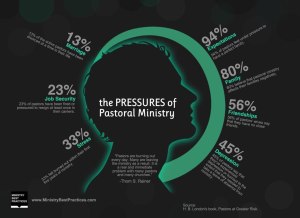
On the Barnabas Ministries website is this helpful graphic taken from Pastors at Greater Risk by H. B. London. It gives you a sense of some of the daunting challenges pastors face today. To this list I would add:

– The celebrity culture in which we live, that denies the glory of the ordinary;

– The pastor’s own insecurities and need for approval;

– The financial problems plaguing our nation and members of the congregation;

– Opposition by Satan, who despises God, the church, church members and church leaders;

– And the increasing suspicion and hostility of the world, which is by nature allergic to God.

All these pressures, and more, demand that we be people who keep in step with the Spirit, fight the good fight of faith, have a set of close friends on whom we can rely, and live out of the Savior’s great love for us in the gospel.

Patience

I met with a fellow ministry leader today who reminded me of a beautiful word: patience.

Pastors are typically not very patient people. We want to see God moving in our congregations. We want to see lives change, prayers answered, the lost found, the saved sanctified. NOW!

I should know. I’m a pastor and I’m not a very patient person.

The thing is, God is an incurably patient God.

Sure, sometimes he acts quickly: shock and awe! But my experience has been that, more often than not, God is in neither the wind, nor the earthquake, nor the fire, but the low whisper that Elijah heard (1 Kings 19:9-12). That’s why God tells us not to despise the day of small things (Zechariah 4:10). Don’t be an impatient pastor. Just be faithful, rejoice when God grants small, incremental gains. Be a pastor who prays, and serves, and cares for your soul, and…waits.

Be patient.

Is this your story?

A pastor who will remain nameless sent me this text message:

Can’t tell you how many times I had to get in pulpit when felt like life was crashing around me and when family seemed to be falling apart. I hold on to the passage that in our weakness He is strong.

What lie about pastoral ministry have we bought into that convinces us our value is determined by how well we entertain in the pulpit, how fast our church is growing, how quickly we get our church out of debt, or how many Twitter followers we have?

When did we decide it’s a bad idea for pastors to have really close friends within their church or to be honest about their failures?

Why must a pastor also be a marketing genius, a fundraiser, a scholar, a motivational speaker, a CEO, a social media guru, and a politician to be considered “effective”?

The stress level on ministers of the gospel today is screaming that it’s time we redefine the work of a pastor. Biblically, here’s the definition:

“Pay careful attention to yourselves and to all the flock, in which the Holy Spirit has made you overseers, to care for the church of God, which he obtained with his own blood” (Acts 20:28, ESV).


Darren’s Story

Darren (not his real name) is a steady, humble, compassionate man. A great pastor. A faithful teacher of God’s Word.

in-depression-630x315But one day, he crashed.

Fresh out of seminary nearly thirty years ago, Darren accepted a call to a small church in an Appalachian community. He was the first full-time pastor the church had ever had. The average age of its two-dozen members was sixty-five. But Darren still carries warm memories of his time among them. He and his wife were married while he served in this little town. Their first child was born there too. But it was clear Darren’s gifts could be used in a wider sphere.

Darren moved his young family to a church in Alabama where he was the solo pastor for nearly ten years. They had a second child. The church held steady in membership. It was a happy experience. But a new opportunity presented itself in the spring of 2000. Darren accepted a call to a bigger church in another Southern suburb.

This church, Darren says, was “dysfunctional.” Darren’s predecessor had been asked to leave. He had replaced a man who was highly regarded—not as a great preacher or administrative leader but as a warm, loving pastor. Unfortunately, Darren’s predecessor was the very opposite. He just didn’t fit. So when Darren arrived, he knew he would need to take his time, build trust, and give the church some much-needed stability. And he did just that.

Things went well for several years. Darren led a reorganization of the elder board and faithfully taught the Bible. But Darren found it a tough church to pastor. People were all over the map theologically. Some voiced their opposition to Darren’s Bible teaching. Some of the people had bad attitudes toward church leaders. Members of the worship team wanted control. Previous elders had refused to confront sin in the church. Now, when the elders tried to put policies in place, some members didn’t like it. Disgruntled, a contingent left the church for greener grass. Several of Darren’s key supporters and friends also left because of job changes. Worse yet, Darren’s assistant pastor, who was a close friend, accepted a call to another church. These losses were hard on Darren and his wife.

Two other events pushed Darren over the edge. He had to put his beloved dog to sleep. But much more devastating, his mother was slowly declining into Alzheimer’s disease. Darren knew she could no longer care for herself, so he moved her out of her house many miles away into an assisted living facility near him. She hated her new home. It was far away from everything familiar. She grew increasingly adversarial, begging Darren over and over to take her back home. But there was no way.

Darren’s mom eventually passed in December, 2013. But her mental and emotional decline, on the heels of all the other losses Darren had experienced, took a terrible toll on him. He shut down emotionally and became almost non-functional. The day of the “crash,” Darren’s wife called the elders and said Darren would not be able to preach that weekend…and maybe not for a long while. He couldn’t get out of bed. He could hardly even speak. For weeks, doing anything at all required enormous energy. Night after night he couldn’t sleep. He says he was never suicidal, but he felt overcome with stress, sadness, and fear.

A caring, older couple invited Darren and his wife to move into their home for as long as they needed. Darren took the next two months off. He got counseling and got on an antidepressant. Slowly the darkness began to lift. He eventually felt like doing a bit of church work. The congregation was very understanding, he says. He was honest with them. He told them about his stress, his sadness, his tendency to isolate himself and not depend on the help of others. Being vulnerable and open actually drew him closer to his people. He grew more understanding of people’s pain. He says he learned the value of sighing.

But in the months following his return, Darren realized something had changed inside him. He no longer felt that he “fit” as a senior or solo pastor.

So earlier this year, Darren resigned.

Darren is now asking the questions he says he should have asked a long time ago: “What’s my gift mix? Where does God want me? What was I made for?” Darren is considering teaching, writing, and mentoring younger pastors.

I asked Darren what, if anything, might have prevented him from crashing in ministry. He says, “If I had grasped that God is for me, that would have helped.” Darren also says he’s realized that as a pastor he always felt isolated, like he was living on an island.

“I’m ready for something different now,” he says.

What to remember when you’re suffering

When we are hurting, it helps to pull out one of the preachers of old and hear him remind us that God ordains affliction for our good and his glory. Here’s what the “Prince of Preachers,” Charles Spurgeon (1834-1892), said about the benefits of suffering:

“God’s great design in all his works is the manifestation of his own glory. Any aim less than this were unworthy of himself. But how shall the glory of God be manifested to such fallen creatures as we are? Man’s eye is not single, he has ever a side glance towards his own honour, has too high an estimate of his own powers, and so is not qualified to behold the glory of the Lord. It is clear, then, that self must stand out of the way, that there may be room for God to be exalted; and this is the reason why he bringeth his people ofttimes into straits and difficulties, that, being made conscious of their own folly and weakness, they may be fitted to behold the majesty of God when he comes forth to work their deliverance. He whose life is one even and smooth path, will see but little of the glory of the Lord, for he has few occasions of self-emptying, and hence, but little fitness for being filled with the revelation of God. They who navigate little streams and shallow creeks, know but little of the God of tempests; but they who “do business in great waters,” these see his “wonders in the deep.” Among the huge Atlantic-waves of bereavement, poverty, temptation, and reproach, we learn the power of Jehovah, because we feel the littleness of man. Thank God, then, if you have been led by a rough road: it is this which has given you your experience of God’s greatness and lovingkindness. Your troubles have enriched you with a wealth of knowledge to be gained by no other means: your trials have been the cleft of the rock in which Jehovah has set you, as he did his servant Moses, that you might behold his glory as it passed by. Praise God that you have not been left to the darkness and ignorance which continued prosperity might have involved, but that in the great fight of affliction, you have been capacitated for the outshinings of his glory in his wonderful dealings with you.” (Morning and Evening, July 19)

Scott’s Story

(The following story comes from Scott Sauls, Senior Pastor of Christ Presbyterian Church (PCA) in Nashville, Tennessee. Thank you, Scott. Read more by Scott on his blog.)

Scott-Sauls-Head-Shot-150x150I am one of those ministers who has endured a handful of seasons of anxiety and depression. Most of the time, thankfully, the affliction has been more low-grade than intense. On one occasion, though, it pretty much flattened me physically, emotionally, and even spiritually. I call this particular season my “living nightmare.”

That season, as well as others, occurred while serving in ministry.

How bad was the living nightmare? I could not fall asleep for two weeks straight. Even sleeping pills could not calm the adrenaline and knock me out, which only made things worse. At night I was terrified of the quiet, knowing I was in for another all-night battle with insomnia that I was likely to lose. The sunrise also terrified me, an unwelcome reminder that another day of impossible struggle was ahead of me. I lost nearly thirty-five pounds in two months. I could not concentrate in conversations with people. I found no comfort in God’s promises from Scripture. I was unable to pray anything but “Help” and “Please end this.”

Why would I tell you this part of my story? Because I believe—no, I am certain—that anxiety and depression hits ministers disproportionately. And a minister who suffers with this affliction, especially in isolation, is a person at risk. When I was in seminary, two pastors committed suicide because they could not imagine going on another day having to face their anxiety and depression. Both suffered with the affliction in silence. One wrote in his suicide note that if a minister tells anyone about his depression, he will lose his ministry, because nobody wants to be pastored by a damaged person.

Or do they?

For those of us in ministry who have suffered (or are suffering) from this affliction, I think we need to do everything we can to discover and embrace an applied theology of weakness. Even the Apostle Paul said that it is in weakness that we discover the glory, power, and grace of God. This is how God works. He is upside-down to our sensibilities. Better said, we are upside-down to his.

Anne Lamott recently said that it’s okay to realize that you are very crazy and very damaged because all of the best people are. Suffering has a way of shaping us as people and as ministers. It has a way of equipping us to lead in ways that are helpful and not harmful. A healer who himself has not been wounded is very limited in his ability to heal.

The “very crazy, very damaged” people in Scripture seem to be the ones through whom God did the greatest things. Hannah experienced bitterness of soul over infertility and a broken domestic situation. Elijah felt so beaten down by ministry that he asked God to take his life. David repeatedly asked his own soul why it was so downcast. Even Jesus, the perfectly divine human, expressed that his soul was overwhelmed with sorrow, even to the point of death. Each of these biblical saints, in her/his own way, was empowered by God to change the world—not in spite of the affliction but because of it and through it.

Charles Spurgeon, the prince of preachers, experienced depression for many years of his ministry. William Cowper, the great hymn writer, had debilitating, paralyzing anxiety for most of his adult life. C. S. Lewis lost his wife to a violent form of cancer. Joni Eareckson Tada became paralyzed from the neck down when she was a teenager. All of these and others were God’s chosen instruments for bringing truth, grace, and hope into the world. The best therapists and counselors have themselves been in therapy and counseling. It’s how God works.

So if anxiety and/or depression is your affliction, I am sharing this part of my story to remind you that there is no shame in having this or any other affliction. In fact, our afflictions may be the key to our fruitfulness as ministers. “Damaged” does not mean “ineffective.” It does not mean “done.”

Anxiety and depression can also, ironically, be a conduit of hope—an opportunity for the foolishness of God to be put on display in our lives. Recently a member in our church (where I have been senior pastor for two years now) told me that he thinks I am a great preacher…and he is entirely unimpressed by this. He told me that the moment he decided to trust me, the moment he decided that I was his pastor, was when I shared openly with the church that I have struggled with anxiety and depression and that I have seen counselors for many years.

As ministers, in the end we may discover that our afflictions had greater impact in people’s lives than our preaching or our vision.

Anxiety and depression are also invitations into Sabbath rest. When you are laid flat and there’s nothing you can do except beg for help, Jesus tends to meet you in that place. It is there that Jesus reminds us that Matthew 11 is for ministers too. He invites weary and heavy laden ministers to come to him and find rest, to learn from him, to experience his humility and gentleness of heart…that we, too, might find rest for our souls. For an anxious, depressed person, there is nothing quite like an easy yoke and a light burden under which to process our pain.

Many times when I have encountered this affliction, it has been through or because of something related to ministry. Usually anxiety and depression have come upon me because I have lost my way temporarily—leaving the easy yoke of Jesus and looking to ministry for self-validation, to make a name for myself, to gain applause and acclaim and respect from the crowds. This is a dead end street, but in moments and seasons of weakness my heart has gone there.

Anxiety and depression have been God’s way of reminding me that I don’t have to be awesome. He has not called me to be awesome, or impressive, or a celebrity pastor, or anything of the sort. He has first and foremost called me to be loved, and to be receptive to that love. He has called me to remember that because of Jesus, I already have a name, I will be remembered even after I am long gone, because he is my God and I am his person. He is my Father and I am his son.

Kierkegaard said that the thorn in his foot enabled him to spring higher than anyone with sound feet. The Apostle Paul said something very similar about the thorn in his flesh. The thorn kept him from becoming cocky. It kept him humble. It kept him fit for God and fit for the people whom God had called him to love and serve. There is glory in weakness. There is a power that is made perfect in that place.

Though I would not wish anxiety or depression on anyone, I am strangely thankful for the unique way that this affliction has led me, time and again, back into the rest of God.

“All the fitness he requireth is to feel your need of him…”

 

Tony’s Story

(The following is based on an interview with a former pastor I’ll call Tony. While the story is true, the names of people have been changed.)

“Tony, you’re a liar. You’re going to have to leave the church.”

Pastor Tony heard the words, but they made no sense. It felt like he’d just been tackled by a 300-lb. linebacker—speared, more like it—and hammered into the ground. The eyes of six deacons seated grimly around the conference table stared blankly at their pastor. Tony grabbed a gulp of air and said, “Excuse me?”

images“You have a pattern of deception in your life, Tony,” said the chairman of the deacon board. “You’re a liar. You’ll need to resign.”

Tony Kendall had been at his church for just three years. The congregation had embraced Tony and his wife Emily with enthusiasm. They loved Pastor Tony’s passion in the pulpit and his knack at connecting Scripture with life. He had hit the ground running. He got the staff pulling in the same direction and sparked renewed vision among the people for blessing the city.

But before long, Tony knew there were problems. In fact, the first sign of an approaching storm appeared the first week he was at the church. One of the trustees took Tony out to lunch and told him the deacons and trustees weren’t on speaking terms. Tony was shocked. This had certainly not come up in the interview process. How could the spiritual leaders of the church allow such a thing?

When the deacons asked Tony to start a contemporary worship service, Tony accepted the challenge but warned them it would not be easy. And Tony was right. It was not easy. Beliefs about worship are about as hard to change as a Long Islander’s accent. But as it turned out, the contemporary worship service was the least of Tony’s problems.

Tony butted heads often with Matthew, his assistant pastor. Matt knew he was on the way out, and made plans to start a church elsewhere in the community. But he would not go quietly. Matt had an ally on the deacon board who was also the board chairman. Matt had often run to Steve whenever he didn’t like something Tony had done or said. Now Matt told him the content of his latest conversation with Tony. He had even recorded the conversation and sent Steve a copy. So several weeks later, at the next board meeting, the chairman asked Tony about something he had told Matt.

“Did you say that or not?”

Tony honestly couldn’t remember. The conversation was several weeks old. “No, I don’t think so. I certainly don’t remember it.”

Steve slammed his fists on the conference table. “Tony, you’re a liar!” He pulled his iPhone out of his pocket and played the recorded conversation for all to hear.

“Well, I guess you’re right. I did say that.”

“You’re going to have to leave the church, Tony,” the deacon said. “There’s a pattern of deception in your life. You can either resign now or we’re going to vote to kick you out of the church.”

Tony was speechless. Yes, he was wrong. He didn’t have his facts straight about a conversation with his assistant pastor. But did this rise to the level of an irreparable breach of trust, a sin that merited dismissal?

What Tony knew that the other deacons sitting around the table that night did not, was that Steve had had a long-running dislike for Tony. He didn’t care for Tony’s preaching. He questioned Tony’s motives for ministry. Whenever Tony looked down at Steve from the pulpit, he would scowl back at him. Matt, the assistant pastor, had totally convinced this fellow leader that Tony was a fraud.

Tony knew it was over. He could fight to stay, but Steve held all the cards. Tony slumped in his chair and said hardly a word the rest of the meeting. His brain was pounding with questions. “What will I do? Where will I go? What will I tell Emily and the kids? How will we sell our home? It’s underwater. How can this be happening?”

As he started his car and pulled out of the church parking lot, Tony knew many tears would fall in the Kendall home that night.

Pain by numbers

One of the keys to surviving in ministry is being open about your pain.

During the General Assembly of the Presbyterian Church in America (my denomination), which met in Houston this past week, I sent out this tweet:

Screen Shot 2014-06-20 at 6.42.40 PM

In no time at all, I got new Twitter followers and a number of retweets and favorites from people I don’t even know. Several pastor friends who had seen my tweet came up and thanked me for it. I’m guessing they just needed someone to tell them they weren’t crazy.

So many ministers of the gospel are carrying the scars of ministry but think they are alone. They are not. According to reputable studies and surveys…

  • 1,500 pastors leave their ministries each month due to burnout, conflict, or moral failure.
  • 23% of pastors have been fired or pressured to resign at least once in their careers.
  • numbers25% don’t know where to turn when they have a family or personal conflict or issue.
  • 33% felt burned out within their first five years of ministry.
  • 40% of pastors and 47% of spouses are suffering from burnout, frantic schedules, and/or unrealistic expectations.
  • 45% of pastors’ wives say the greatest danger to them and their family is physical, emotional, mental, and spiritual burnout.
  • 45% of pastors say they’ve experienced depression or burnout to the extent that they needed to take a leave of absence from ministry.
  • 50% feel unable to meet the needs of the job.
  • 52% of pastors say they and their spouses believe that being in pastoral ministry is hazardous to their family’s well-being and health.
  • 56% of pastors’ wives say they have no close friends.
  • 57% of pastors would leave the pastorate if they had some other option.
  • 70% don’t have any close friends.
  • 75% report severe stress causing anguish, worry, bewilderment, anger, depression, fear, and alienation.
  • 80% of pastors say they have insufficient time with their spouse.
  • 80% believe that pastoral ministry affects their families negatively.
  • 90% feel unqualified or poorly prepared for ministry.
  • 90% work more than 50 hours a week.
  • 94% feel pressured to have a perfect family.
  • “Members of the clergy now suffer from obesity, hypertension and depression at rates higher than most Americans. In the last decade, their use of antidepressants has risen, while their life expectancy has fallen. Many would change jobs if they could” (New York Times, August 1, 2010).

I share this not to create sympathy for pastors nor to give you pastors a reason to boast in your wounds, as though they make you righteous. But we have to admit to ourselves that pastoral ministry is HARD.

The Puritan Richard Baxter (1615-1691) pastored a church in Kidderminster, England, for close to twenty years. He wrote in his journal one day, “…the more I do, the more hatred and trouble I draw upon me.” Marshall Shelley, in his book Leading Your Church through Conflict and Reconciliation, says, “The only pastors who don’t experience regular, character-building periods of conflict, are either bullies who walk all over everyone or cowards afraid to stand up for what God wants to accomplish.”

If there’s one thing I’ve found necessary for my own ministry survival, it is to come out of hiding. Let someone you trust know what you’re going through. Don’t suffer in silence.