
There’s a story recorded twice in the OT about David taking a census of Israel. In one account it says God incited David to do it (2 Sam 24:1ff.), and in another place it says Satan incited David to do it (1 Chron 21:1ff.). I’ll leave it to the theologians to figure that one out. The fact remains, it was a sinful thing for David to do.
Why?
Rick Phillips of Philadelphia’s Tenth Presbyterian Church writes:
“…[this] sin was probably related to a problem with pride and self-reliance. A census was preliminary to a draft of soldiers and a levying of taxes. It seems, therefore, that David’s intent was to increase the royal power in a way that contrasted with humble reliance on God. As Deuteronomy 17 insists, the human kingship of Israel was to be noticeably dependent on God’s divine kingship. For Israel’s king to build up the same kind of power common to pagan kings was tantamount to repudiating God’s over-kingship. This seems to have been the nature of David’s sin so that God was angered and acted to nip it in the bud.”
https://www.tenth.org/resource-library/articles/why-was-davids-census-a-great-sin/
This was a serious sin on David’s part. Because of his action, God gave David a choice of three punishments: three years of famine, three months of being pursued by enemies, or three days of plague. David chose the third option, and the Lord punished Israel with a plague that killed 70,000 men.
David, like all human beings, was enamored with observable metrics instead of the Lord. The same temptation faces us in ministry. The big youth ministry…the big budget…the number of baptisms, converts, new churches, etc.–these are things we look to as measures of success. And they may be measures—but they are not in themselves success.
The thing that strikes me the most in this story is how Joab, David’s general, responded to David.
So the king said to Joab, the commander of the army, who was with him, “Go through all the tribes of Israel, from Dan to Beersheba, and number the people, that I may know the number of the people.” But Joab said to the king, “May the Lord your God add to the people a hundred times as many as they are, while the eyes of my lord the king still see it, but why does my lord the king delight in this thing?” But the king’s word prevailed against Joab and the commanders of the army. So Joab and the commanders of the army went out from the presence of the king to number the people of Israel.
2 Samuel 24:2-4, ESV
Two things we in ministry should take away from this story:
I. If Joab were here, what “thing” would he say you delight in? What are your idols? What do you trust in rather than God?
II. Would you have been bold enough to ask David “Why”?
This brings me to the subject of blowing the whistle. The church today needs whistleblowers.
I noticed in the Thesaurus that the word “whistleblower” has mostly negative connotations: blabbermouth, busybody, fink, informer, rumormonger, rat, nark, squealer, tattletale, troublemaker, bigmouth, snitch.
Maybe in some contexts being a whistleblower is a bad thing. But churches need people like Joab. Churches need whistleblowers.
I look back on my years as a pastor, and I remember times when I should have blown the whistle. I also remember times when I wish someone had blown the whistle on me.
Churches are notoriously guilty of the “runaway train” syndrome. Once an idea gets thrown out there, it gains steam, picks up speed, and sweeps up people, resources, and energy in its wake. But what if it was a bad idea to begin with, and it ends up hurting people, wasting resources, and taking the church backward instead of forward? There are people in leadership in every church whose motto is “ready, fire, aim” instead of “aim, ready, fire.” Often, they are the people with the loudest voice and the most persuasive rhetoric. It takes courage to be a Joab in those situations, but it’s needed.
So here’s what I encourage as a healthy Joab-like response when ideas are being discussed:
(1) When an idea is presented, listen carefully and critically. Listen for inconsistencies, for idealism, for false premises and hidden assumptions.
(2) Ask for the idea to be put in writing. Define words that can be taken different ways. Is the idea reasonable? Does it make sense? Is it “us” or some other church?
(3) Ask “Why do we need to do this?” What problem are we trying to solve? Is it a problem that will go away on its own? Is it worth the cost of time, people, and money? Is it wise? Is now the time? Was it the impulse of one person or many? What sinful motivations may be at work in our hearts?
(4) Consider the unintended consequences of the action. Who will be affected by the decision? Is it sustainable? Who will be the people responsible for keeping it going? Were they part of the decision?
(5) Ask, “Are the elders/deacons/officers of the church behind the decision? Were they even consulted? Will they champion the decision or will we be on our own?”
(6) Once an idea has been discussed and a decision made, sit on it for a while. Pray about it. Bring it back for a second reading. There’s no need to hurry. Often, an idea will fall apart or get refined after some time has elapsed.
(7) Before implementing the decision, float it to those who will be most affected by it. Ask for their input. They may see things from a very different angle.
(8) Be willing to reverse course and apologize if you find out you were misguided.
Beware: There are costs to being a whistleblower. You may not succeed. In the story we’re thinking about, David’s word prevailed over Joab. You may be considered insubordinate, uncooperative, negative, or adversarial. You may be passed over in the future. You may even be fired.
But God gave you a voice. In the Bible, God used whistleblowers (sometimes people of little power and means—Abigail comes to mind) to preserve the kingdom. He can use your voice to pull a church back from a cliff (i.e., plague) and bring blessing to many people. Be confident. Be bold. If you see something, say something.
Think WWJD – What would Joab do?



 I attended a heated meeting of homeowners in my community a few nights ago. It seems that our community golf course is closing and a developer wants to build 304 new homes on it. There are all sorts of problems with this, as was made clear by a couple dozen angry homeowners who spoke at the microphone. I agreed with everything they said. But if I’d had the gumption to approach the mic and speak my mind, this is what I would have said to support my community:
 Here are sixteen practices that will restore your energy if done consistently. Even if you can start with a few of them, you will be taking better care of yourself. And if you want to be any good for those you lead, you need to be good to yourself. I’ve adapted some of these from J. R. Briggs’ book, entitled simply Fail. It’s a great read.
 I recently retired from pastoral ministry and took on a new challenge as Dean of Students at a theological seminary. Now relieved of the responsibilities of church work, I’ve been reflecting on my thirty-two year pastoral career. One of the things I’ve been stunned to realize is just how much those years were filled with anxiety and frantic ambition instead of “the peace that passes understanding” that we Christians talk about.
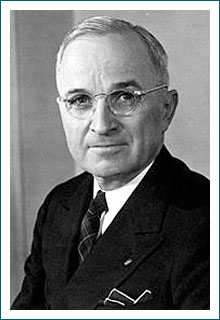 I just finished an excellent biography of Harry S. Truman entitled The Accidental President, by A. J. Baime (New York: Houghton Mifflin Harcourt, 2017). I didn’t know that Truman was considered a highly unlikely candidate for Roosevelt’s Vice-President in 1944. Only two percent of Democratic voters favored him. People outside Missouri didn’t know much about Truman, and what they knew did not impress. He had run a haberdashery in Kansas City, but it went bankrupt. He hadn’t earned a college degree. He had applied for a license to practice law but changed his mind. Most of his business ventures had failed. Truman’s mother revealed that he didn’t even want the V-P job. “They pushed him into it,” she said. His partnership with the gambler Tom Pendergast put a cloud over Truman’s career in the U.S. Senate. His enemies long referred to him as “the senator from Pendergast.”
 philosopher and the most brilliant of all American theologians.”
 in addition to preaching each Sunday and visiting church members.
 Surviving Ministry